The Government of Andhra Pradesh, in partnership with Quest Alliance, Samagra Shiksha (SSA AP), and Leadership for Equity (LFE), recently marked a major milestone —one year of piloting an AI curriculum for Classes 7, 8, and 9 across 100 government secondary schools.
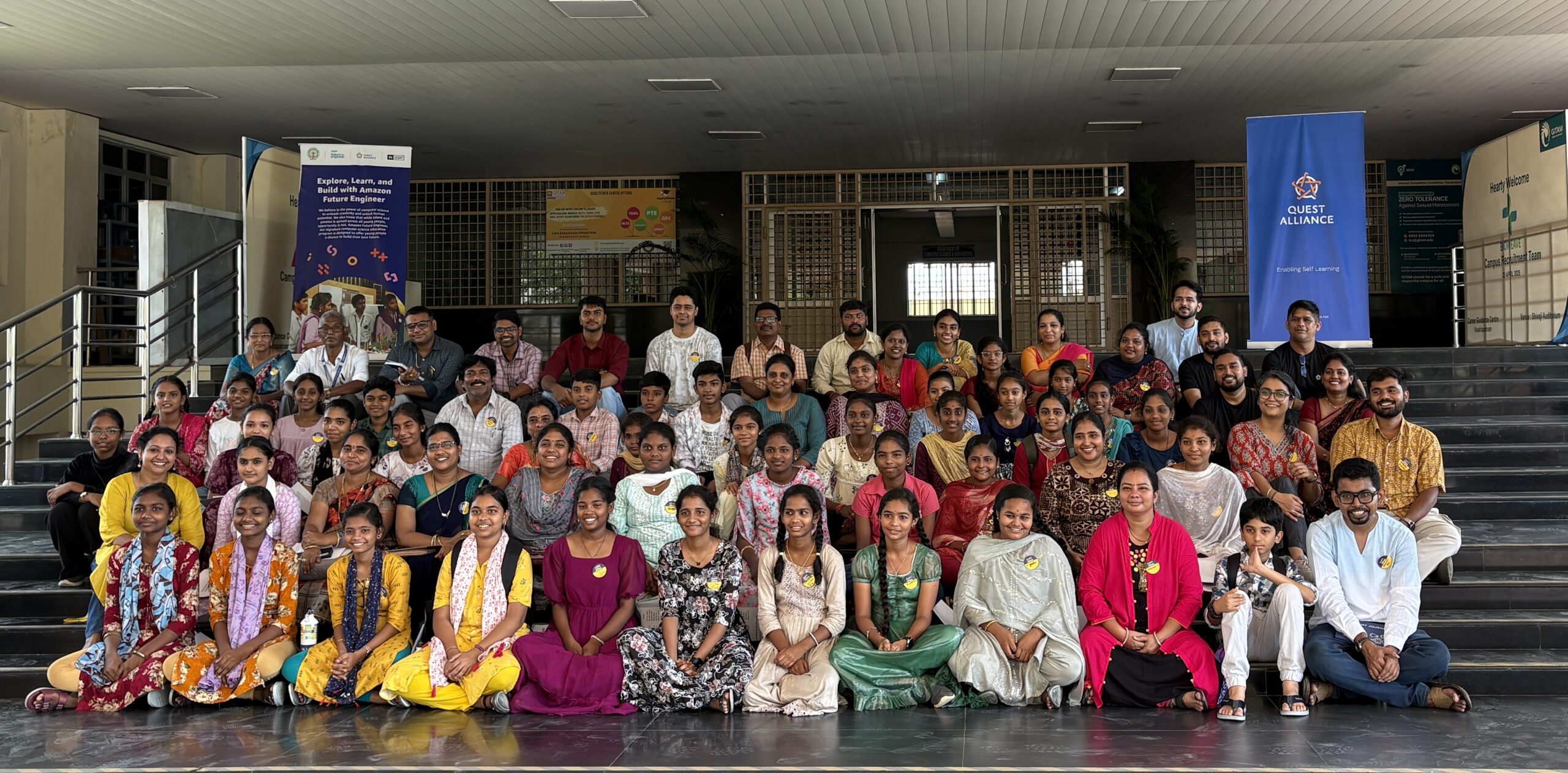
To celebrate, Hack to the Future Andhra 2025 was held at GITAM University, Visakhapatnam, from June 14–17. The event brought together 39 students, 13 teachers, 7 mentors, 2 super mentors, and 2 facilitators to brainstorm, build, and prototype AI-powered solutions for real-world problems.
HTTF is part of a larger movement to bring future-ready skills like computational thinking, ethical AI use, and career awareness into government school classrooms. Over four action-packed days, students refined their problem statements, took part in workshops, and learned to use Amazon’s PartyRock—an intuitive, hands-on GenAI rapid prototyping and App development tool.
Prior to the 4 day event, teachers and students spent their entire summer exploring which problem statements and solutions they would like to work on, with nearly 25-30 hours of input on the Hackathon process. With guidance from their teachers, students learned how to think critically and imagine how AI could solve problems they were affected by personally. Among all the Ideathon sessions, user research data was a crucial element in identifying and finalizing their problem statements. Students pointed out problems in their schools, communities or in their families and peer groups, and interviewed relevant stakeholders through detailed questionnaires.
The depth of their research played a big role in shaping the direction of their projects. This is how some of them described their journey:
“We initially wanted to focus on how to reduce classroom distractions for our project. As we refined our problem statement, we realised that many students struggled to figure out the right career path for themselves. Some students love a subject but choose a different profession. They don’t know how to link the two. Hence, we moved ahead with Career Path Inspire.” – Supriya, who worked on Career Path Inspire
“We conducted research in neighbouring houses, streets and villages. Out of 200 people, 5 had passed away due to throat/stomach cancer/ other health problems due to use of chemical fertilisers and pesticides. In our village, most of the families cultivate their own crops, which they use in their households and sell in the market. They believe that chemical fertilisers give more yield, and lead to no pests, which affects their health.” – Student group that worked on Healthy Veg Guide
“We spoke to 15 farmers in different villages around our school. 90% of the farmers used monocropping for cultivation. They faced problems with low yielding crops and using harmful pesticides and fertilisers to ensure that crops were pest-free. The cost of cultivation went up annually as a result.” – Student Group that worked on Soil Mate
Unlike previous Hackathon workshops, this one stood out for its hands-on, experiential approach, the creative use of AI platforms to design meaningful solutions and being teacher-led from the very start.
“I hope that through this process, they stay curious. The idea of the hackathon is not that students will go out and do the next big invention, but for them to start thinking about things around them – whether it is in nature, in school, or in their community, and feel empowered about being able to solve it without some system or the government needing to be brought in.” – Sameera (Sr. Prog Manager at Quest Alliance)
Learning experience at the CXR Labs, DIYA, WildEd’s tour, etc.
In the lead up to the final event, students explored AR/VR and autonomous labs, and heard from student innovators at GITAM University on how emerging tech can solve real-world problems. Each group also got the opportunity to share their problem statement, research, and ideas during the Gallery Walk, after which they worked on making their solution sharp and focused.
Some students also experienced using a computer for the first time during the 4 days they were on GITAM University’s campus. Sessions were focused on building learner confidence with tech and helped familiarise many students with Amazon’s Party Rock platform (where their final projects were eventually built.)
Highlights of Days 2 and 3 were the robotics demo by through which learners understood that products required the right balance of both software and hardware to function effectively. A natural history museum experience was also curated by which got students thinking about how solutions to everyday problems needed to have deeper thought, engagement and understanding of the ecosystem, with nature also being an inspiration for ideas.
Learners also participated in a beach walk which was organised on Day 2 and designed as a Treasure Hunt. It encouraged keen observation, exploration, and collaborative learning in groups.
After spending the entirety of Day 1 and 2 in workshops, brainstorming sessions and group activities, the students got together for a cultural night where they dressed up, danced, sang, and interacted with students from other groups informally. With mentors joining in from different states as well, participants could reflect on who they were within a shared, multicultural space.
“These spaces not only provide a platform where students can meet each other and share their thoughts, but also exposure to what is happening in the world around them. They explored technology in the career walk, and in the nature walk, explored creative ways through which nature solutions for problems. Such spaces enhance students’ thoughts.” – Abdul (LFE)
- Their journey designing solutions
After refining their problem statements, students needed a better understanding of the PartyRock platform. To support this, they created a sample app as a demonstration through which they learned how to enter prompts, the types of input and output formats, and how the platform generates responses.
Exploring key concepts like Large Language Models (LLMs) helped in building a foundational knowledge of how PartyRock and AI worked. Once students gained a clear understanding of the platform, they began developing their solutions with guidance from their mentors. After numerous rounds of trial and error, each group reached a point where they felt confident and satisfied with their final solution. With that, they shifted focus to preparing for the mock demo.
“This opportunity is very exciting for me — I have been updating my peers on day to day activities I’m a part of during the Hackathon experience. I didn’t ask many questions earlier, and kept to myself, but in yesterday’s workshop, I found myself asking one of the first few questions.” – Usha Rani (Teacher, KGBV Kotturu, Srikakulam, Andhra Pradesh)
“Hackathons are useful for young students, and especially children who are from a rural background and from government schools. It helps expose them to new technology, explore new ideas and introduce them to students and teachers from new places. It’s a great space for them to learn about each other’s culture.” – Kanak Raju (Teacher, APMS Kupili school, Srikakulam District, Andhra Pradesh)
- A feature of each group’s project
Name of Project: Mithr
Names of members:
Problem Statement: Students of class 8 from MCHS Madhavadhara school lack basic and fundamental knowledge of certain subjects which hampers their learning experience.
Solution: Mithr generates personalized worksheets to address learning gaps, boosting confidence, reducing dropouts, and helps create a more educated and empowered future generation.
Based on the AP State board curriculum, Mithr allows learners to select their class, subject, level, type of question and topics or chapters to get customized worksheets which they can solve. An AI assistant is also available for students to address any clarifications.
Name of Project: CycleSaathi
Names of members:
Problem Statement: Girls in residential schools experience irregular periods, and feel shy/uncomfortable to talk about it openly due to stigma associated with menstruation.
Solution: CycleSaathi allows girl students to anonymously track their menstrual cycles and symptoms. The app also provides educational content, reminders, and access to expert advice, helping students manage irregular periods while maintaining privacy and comfort.
Name of Project: Drive Aware
Name of members:
Problem statement: Rash driving at Marikavalasa signal causes frequent accidents.
Solution: Drive Aware tracks driving behavior and gives real-time alerts while also providing personalized safety suggestions to encourage responsible driving habits.
Name of Project: EduEnhance
Name of members:
Problem statement: Social science teachers at KGBV Amadalavalasa lack effective teaching methods which affects student retention between classes 8-10.
Solution: EduEnhance equips teachers with better planning tools, improving classroom engagement and learning outcomes. The tool allows users to describe specific challenges they are facing, practice their lessons and take a quiz to test their knowledge of the subject after.
Name of Project: EduCompanion
Name of members:
Problem statement: Students struggle to grasp Math and Hindi concepts without assistance, which leads to poor results and fear of failure.
Solution: EduCompanion provides detailed, customizable explanations to student queries for Hindi and Math, based on the student’s grade and preferred difficulty level. It also allows asking follow-up questions, offering a truly personalized and interactive learning experience
Name of Project: Weekend Buddy
Problem statement: Hostel students face boredom on weekends, leading to loneliness and conflicts.
Solution: Weekend Buddy suggests fun activities, helping students bond, stay engaged, and encourages creative, positive experiences by bringing people together.
- Name of Project: Healthy Veg Guide
Name of members:
Problem statement: Overuse of chemical fertilizers by Venkatapuram farmers causes soil damage and serious health issues like throat and stomach cancer.
Solution: Healthy Veg Guide is an educational tool for farmers which makes them aware of safe fertilizer use and promotes growing healthier crops.
Name of Project: Parent Communication Helper
Name of members:
Problem statement: Lack of communication between parents and children leads to misunderstandings, poor academics, and low participation.
Solution proposed: Parent Communication Helper offers culturally-aware guidance in Telugu and English to help prepare for sensitive parent-child conversations.
Name of Project: Soil mate
Name of members:
Problem statement: Mono-cropping in Thelukunchi leads to soil degradation, poor yields, and financial instability for farmers.
Solution proposed: A smart assistant; Soil Mate, that analyzes soil, climate, and season to suggest crops, methods, and cost estimates for better farming. The tool empowers farmers with data-driven insights for efficient and profitable farming.
Name of Project: Mind Over Marks
Name of members:
Problem statement: Stress from high academic pressure/ expectations harms the mental and physical health of students.
Solution proposed: Mind Over Marks – a tool which tackles parental awareness about the ill effects their expectations have on children and assesses student stress to maximise well-being and lower stress.
Name of Project: Career Path Inspire
Name of members:
Problem statement: Students between grades 8-10 lack career awareness, which causes them to be disinterested in studies.
Solution proposed: Career Path Inspire helps identify suitable career options for students based on interests, academic strengths, and challenges. It supports students in setting goals and making informed career decisions early on.
Name of Project: Waste Warden
Name of members:
Problem statement: Waste mismanagement in Pedagadili causes mosquito breeding and diseases like Malaria and Dengue.
Solution proposed: An awareness campaign to educate people on proper waste reduction, recycling, and management.
- Name of Project: Smart Meal Buddy
Name of members
Problem statement: Midday meals for students between grade 6-10 are wasted due to their bland taste, which leaves students hungry and unfocused for the rest of the school day.
Solution proposed: An app-based feedback system to improve the taste of midday meals based on student input which will ensure better nutrition for students and enhanced focus in lessons.
Mentors and Jury:
A 10 member jury assessed the ideas based on problem clarity, originality, real-world feasibility, user benefit, and whether they addressed a significant issue. Meet our diverse jury below:
- Chandana (KGBV Ponnada) – Student
- Shraddanjali Mohanthy (MS Palli) – Student
- Steven Suting – Quest Alliance
- Prabjyot – CSR Amazon
- Madhavilatha – State SSA
- Gogul – D.I.Y.A Robotics
- Vimal – WildEd
- Damini – LFE
- Srinivas Prasad (Professor, GITAM)
- Chakravarty (Assistant Professor, GITAM)
Based on the jury’s evaluation, three outstanding teams were selected for their exceptional work in the hackathon. As a reward, Amazon is sponsoring their trip to the Bangalore Maker Space. Soil Mate, Edu Companion: Learn and Grow, and Cycle Saathi were the top three teams.
“Their enthusiasm and finding relatable problems from their immediate life was very cool. There was a project about utilising free time. Who would have thought that was a problem! That group did… and I found that refreshing!” – Gogul, DIYA Robotics (external judge)
“The use of AI was seamless and was an effective tool giving life to the solutions throughout. This was an example in letting AI aid the solution rather than letting AI come up with the solution which ensures creative and critical thinking for the students.” – Vimal, WildEd (external judge)
Schools Program
Our Schools program partners with state governments to equip high school students with critical 21st century skills. Parallel to this, we also support teacher capacity building and curriculum redesign at the state level in AI, computational thinking and future skills. The program is in effect in 5 Indian states – Andhra Pradesh, Gujarat, Jharkhand, Karnataka, and Orissa.
Our work in Andhra Pradesh:
Our work in Andhra Pradesh is driven by a vision to empower the public education system and its stakeholders with future skills to make sure they can thrive in their career. We started with the IBM STEM for Girls program in collaboration with the Commissionerate of School Education (CSE) in Srikakulam and Guntur in 2019 to ensure government secondary school girls entered STEM fields more confidently. We worked in 221 schools reaching over 600+ Educators and around 70,000 children over the 4 years.
In February 2024, we signed an MoU with Andhra Pradesh’s Samagra Shiksha, and partnered with Leadership for Equity and the Amazon Future Engineer program to expand into future skills like Artificial Intelligence. Through our 21st century skill-based approach and the future skills curriculum, we’re working closely with teachers to create localized, tech-enabled learning experiences that are relevant to students’ lives and communities. Our classrooms are designed to help learners explore computational thinking, future skills and careers, so they can make informed choices and be better prepared for the world ahead.
Through a 6-month long pilot in 100 schools in Srikakulam, Vizianagaram and Vizag, we have impacted:
- 23,127 Learners
- 186 Educators
- 99 Schools
- 3 Districts